Nico Pollone has contributed to the JSesh library the very interesting and complex stela Louvre C65, which contains lines of cryptographic texts.
This stela was studied mainly by Etienne Drioton in RdE 11, and its sign list is included in Roberson's Lexicon2. In some places, the cryptographic values are quite certain - in particular, the names and titles of the stela owner and his family are first written in the standard fashion, and then in cryptography. In other parts of the stela, we don't stand on so solid a ground.
You can find the description of this stela along with a photo on the Louvre website.
Cryptography makes transcription a bit more complex, because we can't really rely on signs values. In a normal text, if a bird sign is not readily recognisable, one might infer its identity from its value. But in New Kingdom cryptographic texts, one of the mechanism used is to substitute signs on the basis of their generic shape or family. For instance, in cryptographic texts of the Amduat, the G39 duck can stand for most other bird signs. In C65, any circular sign (ra, zp, ra, X6, N10...) can be used in place of any other circular sign. It might be difficult to identify which sign is actually used.
The photography of the stela, , on the Louvre web site, is quite readable but some signs are a bit too small to distinguish the details. I went to the Louvre to take some high res versions of the signs.
I intend to add an entry to this blog about the translation of the cryptographic text, but meanwhile, I publish this post about the encoding of the signs in the stela.
An interesting point is that Drioton's article features specific typographic signs, which were certainly engraved specially for rendering his texts. Are they listed somewhere? His article was published in the Revue d'Égyptologie. I'd be interested to know who was in charge of the actual typographic aspect of the publication at the time? (to be continued)
Here is a list of the various peculiarities of the text:
Problematic signs
- X6 (X6) or N10 (N10) ???
- we find multiple occurrences of a circular sign with inner drawings. Some are clearly ra, but for others, I was not fully sure if we should understand them as X6 X6 or N10 N10. As I have said, their value is most of the time quite different from the standard value of the sign, which means that linguistic considerations are useless to identify the sign. They more or less stand for any cicular sign - and so do the multiple ra signs. I was even wondering if the two occurrences of the sign represented the same thing.
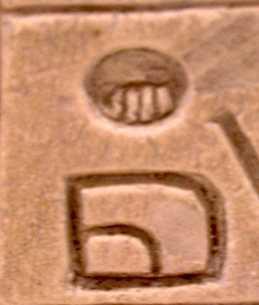
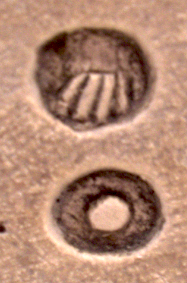
In the second case, reading N10:ra was tantalizing, as it would be a graphic combination of moon and sun. However, the high-res pictures seems to corroborate that both are the same sign, and it's more likely to be X6.
- R10B (R10B) ?
- (l. 1) The sign used for ẖr.t-nṯr represents T28 (T28) and R8 (R8 ) on a sledge. It's not in the Manuel de Codage. Eight variants of (R10) are available. The closest ones are R10B (R10B) which adds a half N26/full N29 (N29) sign, and R10H (R10h), which adds a feather and sticks the T28 and R8 together.
It's an usual problem with graphical variants of hieroglyphs. A given sign may have variants which exhibit different features, which can be combined together. Some are probably not compatible, but it's difficult to foresee which ones. Hence, in theory, if a sign has 6 different binary features, it could have up to 2^6 = 64 different shapes.
The correct approach would be to use a standard R10 or create a specific variant of the sign shape.
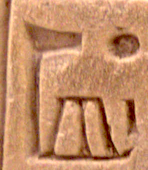
The temptation is great to select R10B nonetheless. The problem with this choice is:
- it gives a reasonnably close visual rendering of the stela;
- but if you are really interested in the sign used and their typology, the encoding is misleading. It's not faithful to the actual variety of drawings, and it adds an occurrence of R10B where there is none.
On the other hand, choosing the standard R10 R10 is also problematic, if at some point you want to seek occurrences which have the exact, standard R10 shape. The current encoding system doesn't differentiate between R10 as a sign type, and R10 as a specific sign shape. With the right encoding system and with a little help of the encoding software, we might do this.
- O36B (O36B) ; N55A (N55A)
- the text uses dotted oval enclosure to write the root ꞽmn or the word ꞽmꞽ. The exact identity of the sign is not clear, and it would probably deserve a code on its own. I got such a sign from Pr. Joshua Aaron Roberson3, and I will use it with the code Z102.
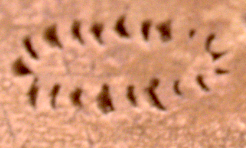
- D382 (D382)
- (l. 6) I have found the code D382 for a combination of a and M12. The actual sign in C65 is a bit different (the hand holds the basis of the stem of M12, not its middle), but it's logically close enough. I suggest a reading which is I think better than the one proposed by Drioton (ḫꜣꜥ): I think the sign can be read as mḫꜣ - actually hardly a cryptographic reading, in the expression mḫꜣ ꞽb (FCD, 115). The arm would be read m.
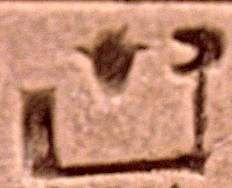
- K2-K3-K5 (Kn ?)
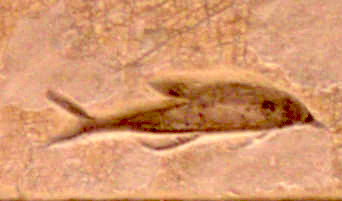
- there are a number of fish-signs, with the reading s. Roberson lists this value for K2, K3 and K5. Even for regular signs, according to Montet, “even phonetic signs, with the possible exception of K1, were more and more badly drawn, and frequent confusions took place as early as the end of the New Kingdom”4. In standard texts, those kinds of confusions would lead me to forego claims to epigraphic accuracy, and encode according to the value of the sign. But once more, in cryptographic texts, those confusions are volontary.
Besides, the drawing and carving of Louvre C65 is of very high quality, as can be observed from those close-up pictures. Two very different fish signs have been used, with the same value.
In line 6, we find a slightly curved fish, with a long dorsal fin, and a pointy head. My feeling, even if the sign is not fully clear, is that it might be an oxyrhynchus fish, K4 K4.
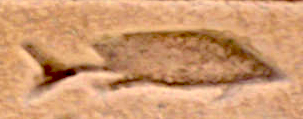
The sign in line 9 is rather different. Its long and horizontal dorsal fin, might point to a K1 K1 tilapia fish, but it's a bit too slender. Its tail does not fit a tilapia sign, either. The generic K5 K5 fish is probably a better fit.5
- Htp (R4)
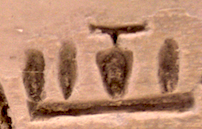
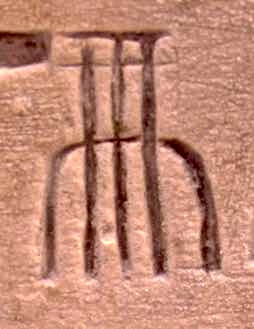
- the stela has a cryptographic writing of ḥtp-dꞽ-nsw, Htp:a-S1. In this spelling, the ḥtp sign is an offering table with three loaves and a beer jug. There is no such sign in the MdC (even if there is a wealth of R4 variants). I have chosen to use the standard code, as the others would be misleading. It might deserve a code of its own.
- A26 holding D53
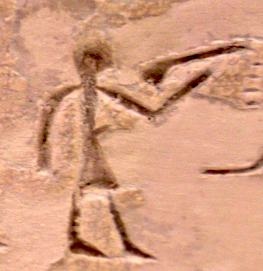
- (l. 8). The words m-bꜣk "in front of" are written with man presenting a D53 sign. The D53 is quite small, but recognisable. I have currently used the group editor to simulate the group.
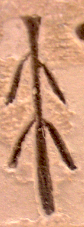
- ms (F31)
- (l. 9) the end of the cryptographic text is quite clear, as it repeats the name of the deceased and his family, available as clear text elsewhere on the stela. In the end of the line, ms is written with a graphical variant of F31 (F31). As F31 ms represents three foxes hides tied together, as seen in the detailled examples, the most likely interpretation is that here we have only one hide. Alternatively, it might be a similar looking vegetal element, a tree branch for instance, as the front two legs are not aligned.
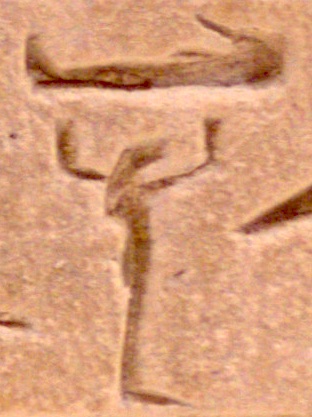
- B64 (B64) ?
- (l. 8) Drioton reads the group A54:B64 as nb=f, with B64 = fꜣꞽ = f. A close look at the sign shows that it is most probably a woman; only one foot is visible, and it also be wrapped in a mummy bandages. It doesn't change the reading, but might be a subtle hint toward the royal underworld guides (I'm thinking of the Book of the Earth, Teil A. 6 Szene for instance6, even if it's probably much later than the stela). It could be interesting to have a specific code for this sign.
Additional question: do the actual occurrences of B64 display one or two feet?
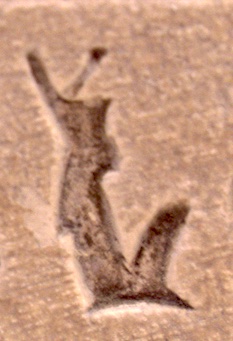
- C185 (C185)
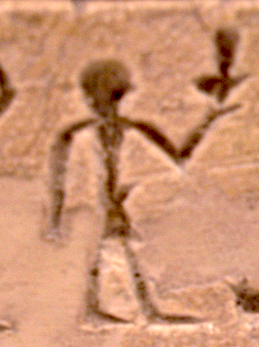
- (l. 7) the sign is not problematic as such, but I wanted to point it out because it had originally been encoded as A45 (A45). A close look at the sign definitly shows it's a female character (basically, a B1 (B1) with a red crown). The difference between the sign in Louvre C65 and the current JSesh sign are stylistic - some of the JSesh signs have marked breasts, which is found in Ptolemaic texts; and the crown is standing over the character's wig in C65. I don't think it deserves a specific code, as C185 is close enough. The sign value is n.
- A391 (A391)
- (l. 7) a man holding a bread loaf; writes the word (ꞽ)t, father. The shape of the bread loaf is a bit different from the standard X2, but it's consistent with the X2 signs in the stela.
- X2 (X2)
- (l. 7, 8, 9) the stela contains quite a few occurrences of the X2 sign, in a shape which is quite close to IFAO 461, 3 and IFAO 461, 4. According to Ben Haring7, we have really two different shapes. In the standard X2, the bread loaf bears the mark of its mould in the bottom. In this variant, the bread loaf is drawn on top of the mould - a feature visible in the variant X2D, albeit in a different way. Similar examples are found in Deir el-Medina tombs,in TT 17 and TT 3358. In our second example, the mould is quite clear. Value: t.
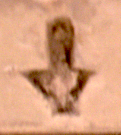
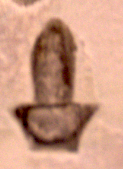
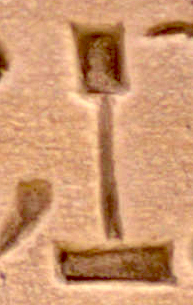
- U127 (U127)
- (l. 6) a drill drilling a stone. There is no explicit source nor description for the shape used in U127 in the sign catalogues. Roberson9 gives a number of different shapes, with the same principle of stone been drilled or carved. Kurth10 lists the MdC signs, considering them as chisels, but explaining that the sign identity and shapes are subject to caution.
Nontheless, the sign in C65 is very close to the Manuel de Codage shape.
Unproblematic signs (but interesting nonetheless)
A number of signs don't pose problems for encoding, but as I took detailled pictures of the stela, I find it would have been a shame not to share them.
- E35 (E35)
- (l. 8) nothing special to say about this sign, which has its standard shape. But as it's not that usual at that period, and the drawing is nice, I include it here :-)
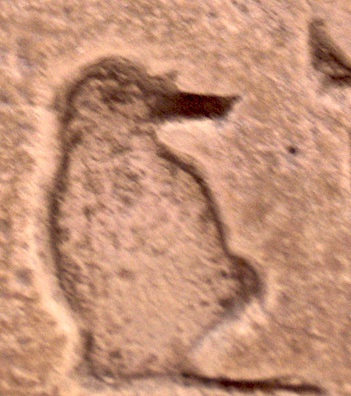
- E134A (E134A)
- (l. 6) nothing special to say here, as the sign in the font and the one in C65 a quite similar. But the original sign is quite nice. The value of the sign here is definitly s, in the writing of the name of the stela owner, Pꜣ-sr. It's interesting, for it's close to the “ptolemaic” usage, when a sign holding an object (here the sign V17, sꜣ), has the phonetic value of this object.
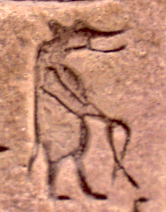
- H5 (H5)
- (l. 6) the sign of the wing is used to write the consonant "p" twice, (pꜣ > p), as the first sign of the name of the stela owner, Pꜣ-sr. I don't think it deserves a new code, even if in the present example it could be a bit peculiar.
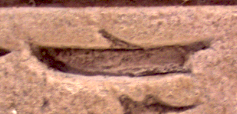
- H8 (H8)
- (l. 6) the first sign of line 6 is probably H8, with the cryptographic value, ꞽmꞽ/ꞽmn. The original encoding used H34, which would have the exact same value, but does not seem justified.
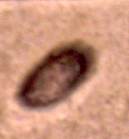
- O211 (O211)
- (l. 7) a closed papyriform column. The existing MdC sign, which is can be found also on Dendera dedicatory texts, is a good fit. The value might be w or ꜥꜣ.
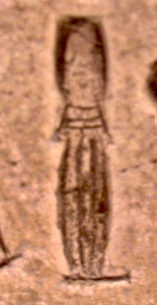
- W17D (W17D)
- This shape of W17 (W17) is quite typical of XVIIIth dynasty texts. We could however have used W17 without losing much information; the sign has its standard value here. The original JSesh sign is correct, but the graphical choice makes it a bit peculiar. A simpler drawing, with plain lines, would probably be better.
A small study of the features of R10 R10
A preliminary (and important) caveat: in the following text, I compare typographic signs. A serious study would need to compare actual, sourced, versions of the glyphs. This being said, I'm speaking of the structure of the font repertoire, so the following discussion is somehow legitimate.
If we look at the various typographic version of R10, we have the following signs:
R10-R10A-R10B-R10C-R10D-R10F-R10G-R10h-R49-R50-R53-R51
How can we describe this? Usually, linguist love binary features. But, if we take, for instance, the position of the nTr sign, it can be at multiple places - in front of the sign, in the middle, in the back of the sign. Using binary features (R8-in-front, R8-in-middle, R8-in-back,) would lead to the possibility of representing multiple occurrences of the R8 sign in R10. It's not the representation we want.
Hence, we choose to have a set of possible values for each features.
A decent representation would be :
| feature | possible values |
|---|---|
| ẖr sign | use T28 / use W11 / use partial T28 /absent |
| ẖr sign position | front / middle / back / irrelevant |
| ntr sign position | front/middle/back/on the ẖr |
| base line | horizontal line/ pedestal/ D36 arm / sledge / none |
| feather | absent / on the ẖr / in front |
| mountain | absent/q at the back/ xAst sign |
note that it could be improved. In fact, when the D36) arm is used as base line, there is no mountain sign, as the upper part of the arm (actually the part which is anatomically the arm itself) also poses as the mountain sign.
R10 R10
Description: a nTr sign standing between a T28 sign and a mountain slope.
| feature | possible values |
|---|---|
| ẖr sign | use T28 |
| ẖr sign position | front |
| ntr sign position | middle |
| base line | horizontal line |
| feather | absent |
| mountain | q at the back |
R10A R10A
Description: a nTr sign standing on an arm holding a T28 sign.
| feature | possible values |
|---|---|
| ẖr sign | use W11 |
| ẖr sign position | front |
| ntr sign position | middle |
| base line | D36 arm |
| feather | on the ẖr |
| mountain | absent |
R10B R10B
Description: a nTr sign standing on a mountain slope ; a T28 sign, both signs standing on a sledge.
| feature | possible values |
|---|---|
| ẖr sign | use T28 |
| ẖr sign position | front |
| ntr sign position | back (or: on the mountain slope?) |
| base line | sledge |
| feather | absent |
| mountain | q at the back |
R10C R10C
| feature | possible values |
|---|---|
| ẖr sign | use T28 |
| ẖr sign position | front |
| ntr sign position | back |
| base line | mountain |
| feather | absent / on the ẖr / in front |
| mountain | xAst sign (cf. base line) |
R10D R10D
| feature | possible values |
|---|---|
| ẖr sign | use T28 |
| ẖr sign position | back |
| ntr sign position | on the ẖr |
| base line | horizontal line |
| feather | in front |
| mountain | absent |
R10F R10F
| feature | possible values |
|---|---|
| ẖr sign | use T28 |
| ẖr sign position | front |
| ntr sign position | on the ẖr |
| base line | horizontal line |
| feather | absent |
| mountain | q at the back |
R10G R10G
| feature | possible values |
|---|---|
| ẖr sign | use T28 |
| ẖr sign position | front |
| ntr sign position | on the ẖr |
| base line | horizontal line |
| feather | in front |
| mountain | q at the back |
R10h R10h
| feature | possible values |
|---|---|
| ẖr sign | use partial T28 |
| ẖr sign position | front |
| ntr sign position | back (or back of the T28) |
| base line | sledge |
| feather | on the ẖr |
| mountain | absent |
R49 R49
| feature | possible values |
|---|---|
| ẖr sign | use W11 ? |
| ẖr sign position | irrelevant |
| ntr sign position | front/middle/back/on the ẖr |
| base line | none |
| feather | on the ẖr |
| mountain | absent |
R50 R50
| feature | possible values |
|---|---|
| ẖr sign | use T28 |
| ẖr sign position | irrelevant |
| ntr sign position | on the ẖr |
| base line | pedestal (?) |
| feather | absent |
| mountain | absent |
R53 R53
IFAO 355, 13
I'm not fully sure it stands for ẖr.t-nṯr; it might possibly be ꞽmnt.t.
| feature | possible values |
|---|---|
| ẖr sign | absent |
| ẖr sign position | irrelevant |
| ntr sign position | back |
| base line | xAst sign |
| feather | in front |
| mountain | xAst sign |
We could be more precise about the feather, and distinguish vertical and oblique feathers.
R51
I'm not fully sure it stands for ẖr.t-nṯr.
| feature | possible values |
|---|---|
| ẖr sign | absent |
| ẖr sign position | irrelevant |
| ntr sign position | middle |
| base line | none |
| feather | absent |
| mountain | q at the back |
Our system is not very good here, and we miss the W sign.
Conclusion
Regarding R10 and its variants. If we consider all possible combinations of features, we would have 4 × 4 × 4 × 5 × 3 × 3 = 2880 combinations. In reality, some of them are not coherent (which means our modeling is a bit lacking), but it gives an idea of the shear possible variety we have to deal with.
When encoding a text, the problem is that it's very likely that an undocumented shape of R10 appears. The encoder would have to:
- choose an existing variant, but end up with a misleading encoding, which would be unhelpful for any study of the sign history; besides, the features of the sign the encoder found relevant when choosing his code would not be explicitly stated (in our case, the main feature is the presence of the sledge, but it's merely our opinion);
- add a new sign. But this would require a proper documentation, especially to allow searches.
A possible, but very time-consuming solution, if working within a XML framework (or any system which allows annotations) would be:
- to encode the character (let's call it R10) ;
- to add an SVG facsimile rendering of the sign ;
- to add a structured description of the signs, listing its features.
The last point would allow, for instance, to search for all occurrences of R10 featuring a sledge and draw up statistics. But obviously, it could be quite time-consuming.
One point which emerges from this analysis, I think, is that the structure of sign variants is quite complex. It's much more a network than a tree.
-
Drioton, E. 1933. “Essais sur la cryptographie privée de la fin de la XVIIIe dynastie”, RdE 1, pp. 1-50. ↩
-
Roberson, J. A. 2020. A Lexicon of Ancient Egyptian Cryptography of the New Kingdom, de Gruyter. ↩
-
Roberson, Joshua Aaron. 2020. A Lexicon of Ancient Egyptian Cryptography of the New Kingdom. p. 182, with code Z8.1. ↩
-
Montet, Pierre. 1914. ‘Les Poissons Employés Dans l’écriture Hiéroglyphique’. BIFAO 11: p. 48. les signes phonétiques eux-mêmes, à l'exception peut-être de K1, furent de plus en plus mal dessinés, et de fréquentes confusions eurent lieu dès la fin du Nouvel Empire. Also, Vernus, Pascal, and Jean Yoyotte. 2005. Le bestiaire des pharaons. Agnès Viénot / Perrin. pp. 65-66. ↩
-
in this particular case, the regular K5 of JSesh is maybe a bit too specific. ↩
-
Hornung, Erik. 1992. Die Unterweltsbücher Der Ägypter. p. 437, fig. 87. ↩
-
Haring, Ben. J. J. 2006. The Tomb of Sennedjem (TT 1) in Deir El-Medina: Palaeography. Paléographie Hiéroglyphique 2. IFAO. p. 134. ↩ ↩
-
Servajean, Frédéric, and Jean-François Gout. 2011. Le tombeau de Nakhtamon (TT 335) à Deir al-Medina: paléographie. Paléographie hiéroglyphique 5. IFAO. p. 121 ↩
-
Roberson, Joshua Aaron. 2020. A Lexicon of Ancient Egyptian Cryptography of the New Kingdom. p. 164. ↩
-
Kurth, Dieter. 2007. Einführung ins Ptolemäische: eine Grammatik mit Zeichenliste und Übungsstücken. p. 407, 411+s ↩