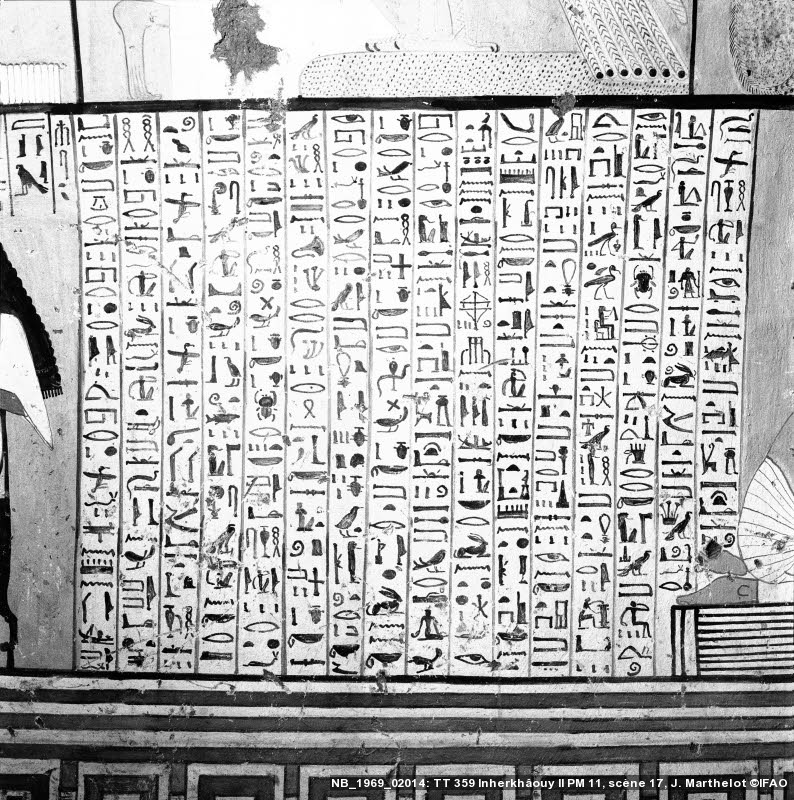
When I proofread the text of Inherkhau's harpist song (TT 359) sent to me by M. Nico Pollone, I found a few cases where the current repertoire of the Manuel de Codage is problematic, or deserves some remarks. I would like to discuss them here.
You can see a photo of the text on the IFAO web site.
the Manuel provides many variants of the sign R10, R10 for ẖrt-nṯr. Most of those variants offer interesting graphical solutions for expressing the idea of necropolis, and can't be considered as mere cosmetic variants.
You find R10A, R10A, R10B, R10B, R10C, R10C, R10D, R10D, R10F, R10F, R10G, R10G, R10h, R10h, R49, R49, R50, R50, and probably R53, R53.
Each of those sign express ẖrt-nṯr in a slightly different way. Some of them use a hill sign, like a half slope N26, other a full N25 sign. In the case of Inherkhau, he uses a sign where the hill is replaced by an arm D36. The closest we get in the Manuel is R10A, R10A. In Inherkhau's version, the nTr sign rests on the arm, not on the beginning of the forearm, and the feather Sw stands vertically on the Xr block.
The question is how those variants are defined and how they should be used. For the signs which have many variants, the risk is that the choice of a particular code could be relatively arbitrary. In this precise case, R10A is probably as good an approximation as we get, and would be a reasonable choice.
the Manuel de Codage lists W59 under varia, and not under a specific kind of vase. In Cauville, fond hiéroglyphique, p. 138, the sign is given the value ḥq.t , which probably means Dr. Cauville sees it as a variant of W22 W22, with the protective net represented by the two horizontal lines.
In Inherkhau's tomb, the sign is used as a determinative for various kinds of vases. In that respect, it is similar to W23 W23, the usual vase determinative.
However, there are two important differences. The neck of the sign in Inherkhau's tomb is much longuer and thinner. Besides, the bottom of the vase is pointy like in W20 or W65, not flat.
The sign in Inherkhau looks like the milk-jug W20 W20, without the leaf covering the milk (see Gardiner, Egyptian Grammar, 3rd ed., p. 530).
The importance of vase profiles in ceramology and the absence of an exact match might suggest that it's probably better to use the standard W23 sign than a somehow similar sign which could point to a much later prototype.
However, the original Manuel de Codage lists quite a few variants for W59, most of them with a pointy bottom.
Interestingly, the shape is found in the much later Taharqa stelae at Kawa (Lenzo, Pal. Hiero. 7, p. 167, § 391), with more or less the same generic use.
the sign for sr, A21, fancies a nice linen dress, with fashionable sleeves.
the M40 sign looks like its unicode version US1M40AEXTU US1M40AEXTU, but with an additional oblique stroke.
Are those particularities worth encoding, and does the Manual, as it stands, provides good solutions for them?
regarding the uses of A76A and the reversal of G37, I think their use is significant and meaningful; they deserve to be encoded;
R10A provides an interesting choice, but it is typically the case where I'd like to have a better view of the sign's history (which in a way is somehow a chicken-and-egg problem);
given the data I have found about W59 W59, I this it might be interesting, in the prospect of writing an history of this sign. It seems to appear in quite a few XXVth dynasty texts, often linked to vases of Napatean origin. It's obviously not the case here, but one would like to have a better panoramic view on the sign's history;
I find the problems of US22 U22 and W17D W17D less interesting, but it's somehow subjective.